
TL;DR:
- Most B2B marketers rely heavily on LinkedIn for lead generation, with 95.7% adoption.
- Effective LinkedIn strategies focus on quality content, relationship-building, and targeting decision-makers.
- Permission-based, valuable engagement on LinkedIn outperforms volume-driven tactics and boosts ROI.
Most B2B marketing executives believe spreading budget across multiple channels is the safest path to growth. The data tells a different story. 95.7% of B2B marketers rely on LinkedIn for lead generation, making it the single most dominant channel in the B2B toolkit. Yet many organizations still treat it as just another social platform, posting inconsistently and measuring nothing. This article breaks down why professional networks, and LinkedIn specifically, outperform every alternative, what the numbers actually show, and how to build a repeatable framework for partnerships, brand influence, and measurable ROI.
Table of Contents
- The strategic value of professional networks in B2B marketing
- How LinkedIn delivers measurable results: Data, tactics, and ROI
- Defining best practices: What marketers miss when leveraging LinkedIn
- Real-world application: Building partnerships and brand influence with LinkedIn
- The uncomfortable truth about leveraging professional networks on LinkedIn
- Ready to scale your LinkedIn impact?
- Frequently asked questions
Key Takeaways
| Point | Details |
|---|---|
| LinkedIn dominates B2B growth | Most B2B marketers see more leads, higher deal influence, and better ROI using LinkedIn. |
| Quality beats quantity | Weekly, in-depth thought leadership posts yield better engagement and conversions than daily updates. |
| Strategic partnerships boost results | Effective engagement and employee advocacy on LinkedIn can quickly amplify brand partnerships and trust. |
| Avoid automation pitfalls | Over-posting and impersonal outreach harm reputation; focus on permission-based engagement strategies. |
The strategic value of professional networks in B2B marketing
Professional networks operate on a fundamentally different logic than consumer social media. On LinkedIn, your audience is not scrolling for entertainment. They are actively seeking insights, evaluating vendors, and building relationships that drive business decisions. That context changes everything about how trust is built and how deals get done.
Warm introductions convert at dramatically higher rates than cold outreach. When a mutual connection vouches for your brand or a respected peer shares your content, the credibility transfer is immediate. This is not a soft benefit. It is a measurable conversion lever that shortens sales cycles and increases average deal size.
“LinkedIn is not just a channel. It is the professional context where B2B decisions are made, validated, and accelerated.”
Here is why LinkedIn specifically dominates for B2B marketing executives:
- Senior decision-maker access: LinkedIn concentrates C-suite executives, VPs, and directors in one place, with targeting tools precise enough to reach them by title, company size, and industry.
- Trust and authority signals: Thought leadership content positions your brand as a credible voice before any sales conversation begins.
- Referral and advocacy mechanics: Employee shares, endorsements, and comments amplify reach organically in ways that paid ads cannot replicate alone.
- Deal acceleration: Warm network introductions reduce friction at every stage of the funnel.
The platform’s LinkedIn marketing ROI advantage is also backed by hard adoption data. LinkedIn is used by 95.7% of B2B marketers for lead generation and delivers 43% higher response rates compared to cold email outreach. That gap is not marginal. It represents a structural advantage rooted in professional context and permission-based engagement.
Compare this to Instagram or X, where B2B audiences are fragmented and intent signals are weak. LinkedIn users are in a professional mindset when they engage, which means your message lands in a completely different cognitive environment. For marketing executives managing limited budgets and demanding pipeline targets, that distinction is the difference between wasted spend and scalable growth.
How LinkedIn delivers measurable results: Data, tactics, and ROI
Let’s get precise. The numbers behind LinkedIn’s performance are not incremental improvements over other channels. They represent category-level outperformance that should reshape how you allocate marketing resources.
Strategic LinkedIn posting yields 3.2x more qualified leads compared to passive or inconsistent activity, and 68% of B2B marketers report direct deal influence from their LinkedIn presence. On the paid side, LinkedIn Ads deliver 121% ROAS, outpacing Google at 67% and Meta at 51%.
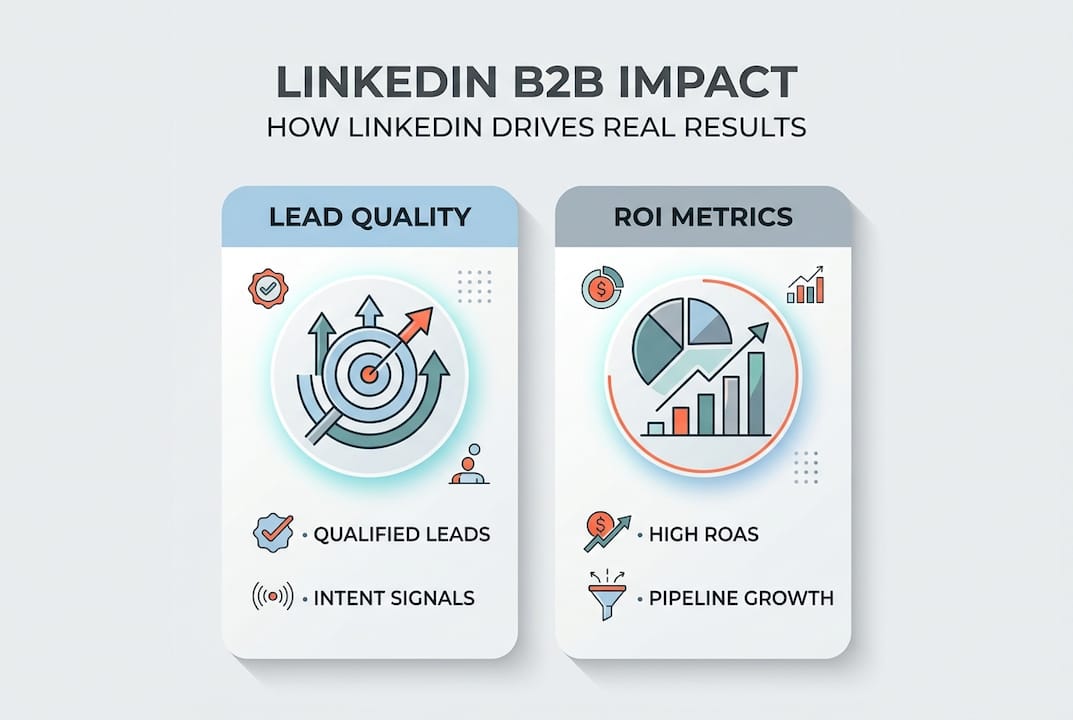
| Platform | ROAS | B2B lead quality |
|---|---|---|
| 121% | High (professional intent) | |
| 67% | Medium (search intent) | |
| Meta | 51% | Low to medium (consumer context) |
These figures are not theoretical. They come from real campaign data and should inform your next budget conversation.
Here are four essential steps to maximize your LinkedIn results:
- Define your audience precisely. Use LinkedIn’s targeting to filter by job title, seniority, company size, and industry. Broad targeting wastes budget and dilutes message relevance.
- Commit to weekly thought leadership content. Consistency matters more than volume. One deeply researched post per week outperforms five shallow updates every time.
- Engage before you broadcast. Comment meaningfully on prospects’ and partners’ content before publishing your own. This warms the relationship and increases your content’s organic reach.
- Track and optimize with intent. Use measuring LinkedIn ROI frameworks to connect content activity to pipeline metrics, not just vanity engagement numbers.
For aligning LinkedIn marketing goals with revenue targets, the key is mapping each tactic to a specific funnel stage. Awareness content builds authority. Engagement content nurtures leads. Direct outreach converts.
Pro Tip: Depth beats frequency on LinkedIn. A 1,200-word post that teaches something genuinely useful will generate more qualified inbound than ten short updates combined. Invest in the thinking, not just the publishing cadence. 🎯
Defining best practices: What marketers miss when leveraging LinkedIn
Now that you know what works, here is what most marketers get wrong, and how to sidestep these traps.
The most common mistake is treating LinkedIn like a broadcast channel. Executives post company announcements, product updates, and promotional content, then wonder why engagement is flat. LinkedIn’s algorithm and its audience both reward genuine insight and professional generosity, not self-promotion.

Quality and depth in LinkedIn posts outperforms high-volume updates, and over-posting combined with automation can actively harm your reputation and pipeline. This is a critical distinction.
| Approach | Result |
|---|---|
| Daily automated posts | Declining reach, audience fatigue, trust erosion |
| Weekly in-depth thought leadership | Stronger engagement, qualified inbound, deal influence |
| Personal page content | Higher organic reach and credibility |
| Company page only | Lower visibility, weaker relationship signals |
Here are the five dos and don’ts every marketing manager should internalize:
- ✅ Do publish weekly posts that teach, challenge, or reframe a real business problem.
- ✅ Do engage authentically in comments before and after publishing.
- ✅ Do use personal profiles to amplify company content with genuine perspective.
- ❌ Don’t automate connection requests or follow-up messages. It signals low intent and damages brand perception.
- ❌ Don’t over-promote. A good rule: for every promotional post, publish three value-driven pieces.
Building thought leadership on LinkedIn requires patience and consistency, but the compounding effect is real. Audiences that trust your perspective are far more likely to respond to outreach, accept introductions, and convert into partners or clients.
Your LinkedIn workflow for marketing should be built around permission-based engagement. That means earning attention through value before asking for anything in return.
Pro Tip: Map your content calendar to your buyers’ decision stages. Early-stage prospects need education. Mid-funnel contacts need proof. Late-stage leads need social validation. One size does not fit all. 📅
Real-world application: Building partnerships and brand influence with LinkedIn
Having identified best and worst practices, here is how to put this knowledge to work, step by step, for actual growth.
Consider a B2B SaaS company targeting enterprise HR directors. Rather than cold outreach, their marketing team activates a four-step partnership framework on LinkedIn:
- Map your network strategically. Identify second-degree connections at target accounts. Look for shared connections who can provide warm introductions. This single step can cut your outreach response time in half.
- Activate employee advocacy. Equip your team with ready-to-share content that adds their personal perspective. Strategic engagement and employee advocacy amplify LinkedIn results, with 68% of marketers reporting direct deal influence from this approach.
- Collaborate with LinkedIn creators. Partnering with trusted voices in your niche accelerates credibility. A creator who already has the trust of your target audience can introduce your brand in a way that no ad can replicate.
- Nurture before converting. Engage with your target partners’ content consistently over several weeks before making any direct ask. This transforms cold contacts into warm relationships.
“The brands winning on LinkedIn are not the loudest. They are the most consistently useful to the people they want to reach.”
For LinkedIn strategic partnerships, the goal is to create a network of mutual value, not a list of contacts to pitch. When you build LinkedIn communities around shared professional interests, you become a connector, not just a vendor.
Exploring LinkedIn creator partnerships adds another dimension entirely. Creators bring engaged, niche audiences and authentic voices that amplify your brand’s message far beyond what a company page can achieve alone. This is where influencer marketing on LinkedIn becomes a genuine growth engine rather than an experiment.
The uncomfortable truth about leveraging professional networks on LinkedIn
Most B2B leaders know they should be more active on LinkedIn. They post occasionally, run a few ads, and call it a strategy. The uncomfortable truth is that surface-level activity produces surface-level results.
What actually separates high-performing LinkedIn strategies from average ones is not budget or posting frequency. It is intentionality. The executives and brands that win on LinkedIn treat every interaction as a relationship investment, not a transaction. They engage with genuine curiosity. They share perspectives that make their audience think differently. They build true thought leadership by saying things worth remembering, not just things that are safe to publish.
We have seen brands with modest followings generate seven-figure pipeline from LinkedIn simply because they were relentlessly useful to a specific audience. And we have seen well-funded companies with large pages generate almost nothing because their content was generic and their outreach was automated.
The lesson is clear: permission-based relationships built on real value outperform any volume-based tactic. Stop optimizing for impressions. Start optimizing for trust. That shift in mindset is where real LinkedIn leverage begins. 💡
Ready to scale your LinkedIn impact?
If these strategies resonate, the next step is execution at scale. Kawaak is built specifically for B2B brands and marketing teams that want to run high-impact influencer campaigns on LinkedIn, connecting directly with LinkedIn creators who can amplify your message to the right professional audiences.
Whether you are launching your first LinkedIn campaign or looking to systematize creator partnerships, the Kawaak platform gives you the infrastructure to move fast and measure what matters. Explore our LinkedIn campaign solutions to see how leading B2B brands are turning LinkedIn influence into pipeline. The strategies in this article work. Kawaak helps you deploy them with precision and scale. 🚀
Frequently asked questions
What makes LinkedIn the best professional network for B2B marketing?
LinkedIn leads B2B channels because 95.7% of B2B marketers rely on it for lead generation, it concentrates senior decision-makers, and it delivers 43% higher response rates than cold email outreach.
How often should B2B brands post on LinkedIn for best results?
Weekly, high-quality thought leadership posts consistently outperform daily updates, generating 3.2x more qualified leads and stronger deal influence than high-frequency, low-depth content.
Does LinkedIn outperform other social channels in advertising ROI?
Yes. LinkedIn Ads deliver 121% ROAS, significantly outranking Google at 67% and Meta at 51% for B2B advertisers.
What’s the biggest pitfall when leveraging LinkedIn for B2B partnerships?
Automating outreach and over-posting can harm reputation and reduce lead quality. Permission-based, value-driven engagement consistently outperforms volume-based tactics.