
TL;DR:
- Slow approval processes hinder timely LinkedIn influencer campaigns by limiting reach and relevance.
- Implementing a centralized, async workflow with clear roles accelerates content approval and boosts performance.
- Limiting approvers, using AI tools, and defining clear briefs improve efficiency and protect brand integrity.
Slow content approvals are quietly killing your LinkedIn influencer campaigns. By the time a post clears three rounds of committee feedback and two compliance reviews, the trending conversation it was meant to join has moved on. For B2B marketing teams running influencer or employee advocacy programs on LinkedIn, an inefficient approval process doesn’t just create friction — it directly erodes reach, relevance, and ROI. This article walks you through a practical, scalable framework to build a fast, compliant, and repeatable content approval system that keeps your campaigns moving at the speed LinkedIn demands.
Table of Contents
- Understand the LinkedIn influencer content approval challenge
- Set up the right tools and team for streamlined approvals
- Map the ideal content approval workflow for B2B influencers
- Common pitfalls and smart fixes
- Why most B2B teams overcomplicate influencer content approval
- Power your LinkedIn influencer campaigns with Kawaak
- Frequently asked questions
Key Takeaways
| Point | Details |
|---|---|
| Keep approval teams lean | Limit to three roles—creator, editor, approver—for faster turnaround and better accountability. |
| Centralize your workflow | Use a single platform to manage all feedback, revisions, and approvals to avoid email chaos. |
| Prioritize clear briefs | Invest time in detailed briefs to reduce confusion and roundtrips during approval. |
| Leverage compliance automation | AI tools can handle routine checks, keeping content fast and risk-free. |
| Empower authentic voices | Let employee advocates post to maximize reach and credibility. |
Understand the LinkedIn influencer content approval challenge
LinkedIn’s feed moves fast. A post that lands on Monday morning can generate most of its impressions within 24 to 48 hours. That reality makes traditional multi-level approval processes a serious liability for B2B marketing teams. When content has to pass through legal, brand, management, and communications before it goes live, you’re not protecting the campaign — you’re strangling it.
The core tension is this: B2B companies are naturally risk-averse, and that instinct pushes them toward committee-based approvals. But approval by committee slows down the process and should be avoided for B2B influencer content. The more stakeholders involved, the more rounds of revision, the more diluted the final message becomes.
There’s also a strategic reason to prioritize influencer and employee-generated content over standard company page posts. Posts from employee profiles get 5 to 10 times the reach versus company pages. That’s a significant performance gap, and it means your approval process needs to support the people posting, not just protect the brand.
Here are the top barriers marketing teams consistently run into:
- Committee slowdowns: Too many approvers with conflicting priorities and no clear decision-maker
- Unclear briefs: Influencers or advocates don’t know what’s expected, leading to multiple revision cycles
- Scattered communication: Feedback arrives via email, Slack, WhatsApp, and comments simultaneously
- Compliance anxiety: Teams over-index on legal risk without a clear framework, causing paralysis
These barriers compound each other. An unclear brief leads to a weak draft, which triggers more feedback, which requires more approvers, which delays the post. Breaking this cycle starts with understanding that speed and quality aren’t opposites — they’re both served by a tighter, smarter process. Learning how to boost B2B LinkedIn engagement starts with fixing the system behind the content, not just the content itself. And if you’re looking for inspiration on what to actually post, exploring LinkedIn campaign ideas can help you build a brief library that reduces revision cycles from the start.
Set up the right tools and team for streamlined approvals
Once you’ve identified where your approval process breaks down, the next step is building the infrastructure to fix it. That means choosing the right tools and assembling a lean team structure that can move quickly without sacrificing oversight.
Centralized tools like Asana, Monday.com, InfluenceFlow and Slack integrations give your team visibility into every piece of content at every stage. AI can also help with compliance checks, flagging potential issues before a human reviewer even sees the draft. This dramatically reduces the back-and-forth that eats up approval time.

Here’s a quick comparison of common tools and their strengths for LinkedIn influencer approval:
| Tool | Best for | Key strength |
|---|---|---|
| Asana | Task-based workflows | Clear ownership and deadlines |
| Monday.com | Visual pipeline tracking | Status visibility across campaigns |
| InfluenceFlow | Influencer-specific review | Built-in creator collaboration |
| Slack (with integrations) | Real-time feedback loops | Fast async communication |
| Google Docs | Simple draft review | Easy commenting and version history |
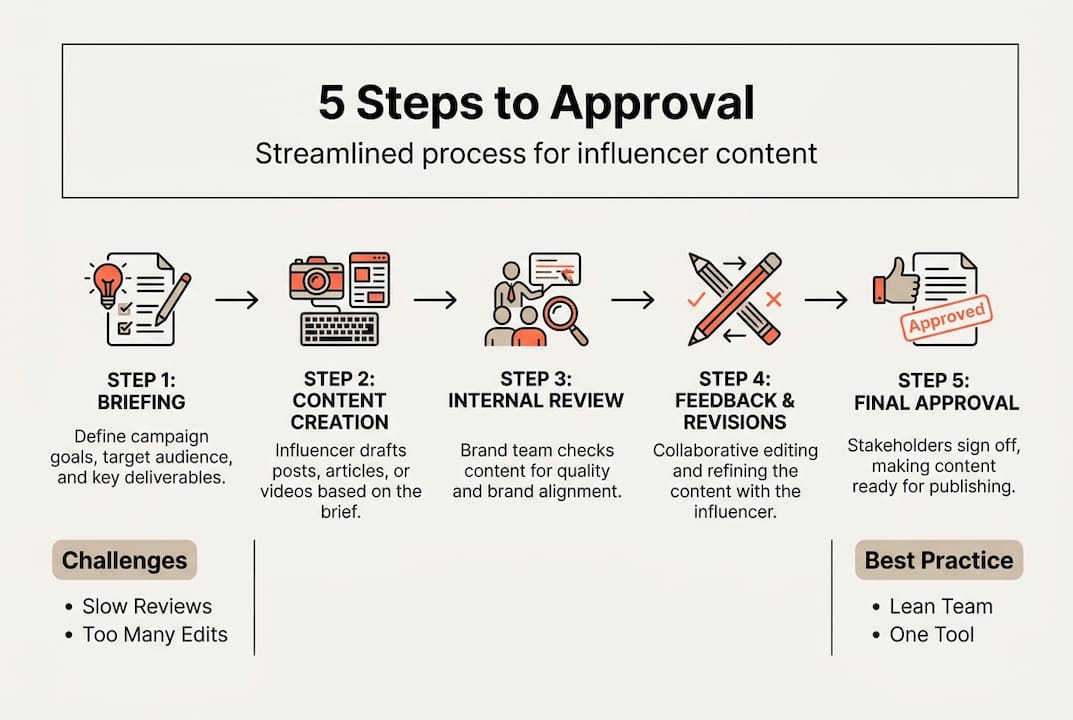
Beyond tools, team structure matters just as much. B2B workflows thrive with 3 roles max: creator, editor, and approver. Each role has a defined lane. The creator drafts the content based on the brief. The editor checks for tone, accuracy, and alignment. The approver gives the final green light. That’s it.
Why does this work? Because accountability is clear. There’s no ambiguity about who has the ball at any given moment, and there’s no room for passive blockers who delay without adding value.
When building your team structure, keep these principles in mind:
- One decision-maker per campaign: Avoid shared approval authority, which creates bottlenecks
- Defined SLAs: Each role should have a maximum turnaround time (e.g., 24 hours for review)
- Async-first communication: Default to written feedback in the tool, not meetings
Pro Tip: Document your team’s roles and SLAs in a one-page brief at the start of every campaign. It takes 10 minutes and saves hours of confusion later. A well-structured LinkedIn content workflow is the foundation everything else is built on.
Map the ideal content approval workflow for B2B influencers
With the right tools and team in place, you can now build a workflow that’s repeatable, fast, and scalable. The goal is a process that any team member can follow without needing to ask questions at every step.
Clear briefs and a weekly cycle — ideating on Monday, reviewing on Wednesday — empower advocates and reduce revisions significantly. Here’s what that looks like in practice:
- Monday: Ideation and brief distribution. The marketing lead shares the week’s content brief with all creators. The brief includes the topic, key message, tone guidelines, and any compliance notes.
- Tuesday: Drafting. Creators write their posts and submit them to the centralized tool by end of day.
- Wednesday: Editorial review. The editor reviews all drafts, leaves specific feedback, and returns them to creators.
- Thursday: Revisions and final submission. Creators incorporate feedback and submit final versions for approval.
- Friday: Final approval and scheduling. The approver reviews and schedules posts for the following week.
This cycle keeps content moving without requiring daily check-ins or emergency reviews. It also gives creators enough time to produce authentic, high-quality content rather than rushing to meet a same-day deadline.
Here’s a comparison of async versus meeting-based approval approaches:
| Dimension | Async workflow | Meeting-based workflow |
|---|---|---|
| Speed | Fast, 2 to 3 day turnaround | Slow, depends on calendar availability |
| Scalability | High, works across time zones | Low, requires scheduling coordination |
| Feedback quality | Written, specific, trackable | Verbal, often vague, hard to reference |
| Creator autonomy | High | Low |
| Risk of bottleneck | Low | High |
The async model wins on almost every dimension for B2B influencer campaigns. It respects creators’ time, keeps the process transparent, and makes it easy to spot where delays are happening. For more real-world context on what high-performing content actually looks like, reviewing B2B content examples can sharpen your brief templates and reduce revision cycles.
Common pitfalls and smart fixes
Even a well-designed workflow will hit friction points. The key is knowing what to watch for and having a fix ready before it derails your campaign.
Mistake 1: Email-based feedback chaos. When feedback arrives across five different channels, creators can’t tell which version is current or whose comments take priority. Centralizing feedback and using clear briefs reduces revision chaos and keeps everyone aligned.
Fix: Mandate that all feedback happens inside your chosen project management tool. No exceptions. If a stakeholder sends feedback via email, the editor moves it into the tool before acting on it.
Mistake 2: Committee approval creep. A campaign starts with two approvers, then legal wants in, then the CMO asks to review, and suddenly six people are signing off on a 300-word LinkedIn post.
Fix: Limit approvers to three roles maximum and document this boundary in your campaign brief. If someone outside the core team wants input, route it through the editor, not directly to the creator.
Mistake 3: Vague compliance guidelines. When creators don’t know what they can and can’t say, they either over-sanitize their content (killing authenticity) or post something that triggers a last-minute legal review.
Fix: Build a one-page compliance brief template that covers disclosure requirements, restricted topics, and approved messaging. Use AI tools to run a first-pass compliance check before human review. This is especially important if you’re scaling across multiple LinkedIn influencer vetting processes simultaneously.
Pro Tip: Run a monthly audit of your approval timeline. If any post took more than five days to approve, identify exactly where it stalled and fix that step before the next campaign.
Balance control with creator freedom — don’t over-police authentic voices. The most effective LinkedIn content sounds like a real person, not a press release. Your approval process should protect the brand without erasing the creator.
Why most B2B teams overcomplicate influencer content approval
Here’s an uncomfortable truth: most B2B marketing teams don’t overcomplicate approvals because they’re being careless. They do it because control feels safe. Every additional approver feels like a layer of protection. Every extra review cycle feels like due diligence. But this instinct, however understandable, consistently produces worse outcomes.
Brands that empower their advocates within basic guardrails consistently outperform those with strict gatekeeping. The data on LinkedIn B2B marketing outcomes is clear: reach and conversion improve when content feels authentic, and authenticity requires creative freedom. A post that’s been revised six times by six different stakeholders doesn’t feel human anymore.
The competitive advantage in 2026 belongs to teams that trust their creators, set clear boundaries upfront, and then get out of the way. Streamlined approval isn’t just an operational efficiency — it’s a direct driver of campaign performance. Less friction in the process means more content published, more consistently, with more impact. That’s the equation worth optimizing for. 🎯
Power your LinkedIn influencer campaigns with Kawaak
You now have the framework. The next step is putting it into practice with tools built specifically for LinkedIn influencer campaigns.
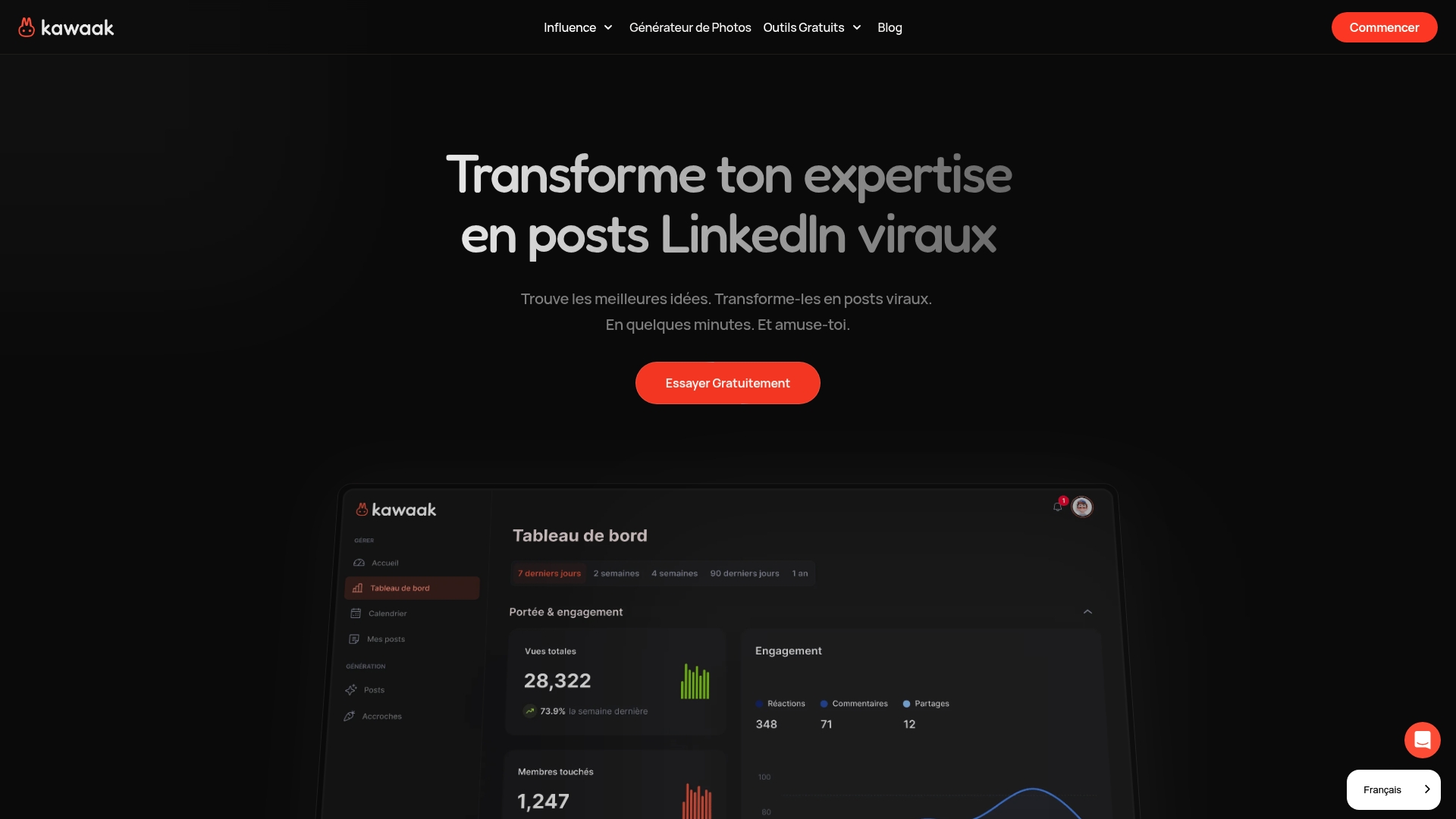
Kawaak is designed exactly for this: connecting B2B brands with LinkedIn creators and giving marketing teams the workflows they need to manage approvals efficiently. Whether you’re running your first influencer campaign or scaling an existing program, Kawaak Campaigns gives you the structure to move fast without losing control. Creators get clear briefs and a smooth submission process. Marketing teams get visibility, accountability, and speed. It’s the operational backbone your LinkedIn strategy has been missing. 🚀
Frequently asked questions
What is the best approval workflow for LinkedIn influencer content?
Use a three-step workflow: ideation, peer or compliance review, then final approval, all handled in a centralized tool. B2B LinkedIn workflows work best with a three-role structure: creator, editor, and approver.
How do you ensure compliance without slowing down approvals?
Automate routine compliance checks using AI and provide clear briefs so reviewers can move quickly. AI tools can automate compliance tasks for influencer content, reducing manual review time significantly.
Why use employee advocates for LinkedIn campaigns?
Employee profiles can get 5 to 10 times more reach than company pages, making them far more effective for campaign distribution and audience engagement.
What tools work best for B2B influencer content approval?
Centralized tools like Asana, Monday.com, and InfluenceFlow streamline influencer content approvals by giving all stakeholders visibility and a single source of truth for feedback.