
TL;DR:
- Organic reach on LinkedIn has declined by 60 to 80% due to algorithm changes and platform prioritization of paid ads.
- Early engagement within the first two hours after posting is critical for maximizing organic distribution.
- High-quality, native content combined with influencer collaboration and active engagement strategies remains essential for success.
LinkedIn organic reach is no longer the free growth engine it once was. If you’ve noticed your posts reaching fewer people despite strong content, you’re not imagining it. Organic reach is the number of unique users who see your content without paid promotion, and it’s become one of the most misunderstood metrics in B2B marketing. The algorithm keeps evolving, making visibility feel unpredictable. This guide cuts through the confusion: you’ll learn exactly how organic reach works, why it’s declining, and what B2B marketers and brand managers can do right now to stay competitive on LinkedIn.
Table of Contents
- Defining organic reach on LinkedIn
- How LinkedIn’s algorithm determines organic reach
- The decline of organic reach: What’s changed in 2026?
- How to maximize organic reach for B2B influencer campaigns
- Why quality and adaptation now define organic reach on LinkedIn
- Amplify your B2B results with LinkedIn campaign expertise
- Frequently asked questions
Key Takeaways
| Point | Details |
|---|---|
| Organic reach definition | Organic reach is unpaid content exposure to unique users shaped mainly by LinkedIn’s algorithm and network activity. |
| Algorithm priorities | Engagement velocity and content relevance are now key to expanding your LinkedIn reach organically. |
| Declining reach trends | Organic reach has dropped up to 80% from peak levels, meaning strategy and quality matter more than ever. |
| B2B best practices | B2B marketers must focus on creative, engaging posts and leverage influencer advocacy to maximize reach in 2026. |
Defining organic reach on LinkedIn
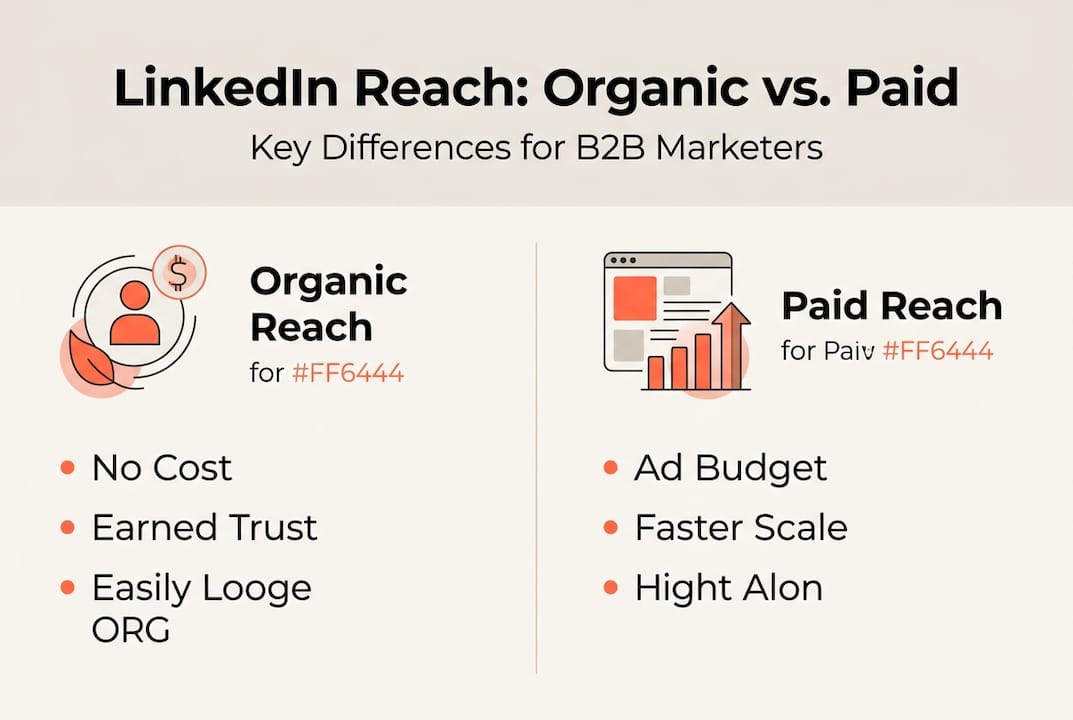
Let’s get precise. Organic reach on LinkedIn is the count of unique users who view your post without any paid amplification behind it. It’s purely driven by LinkedIn’s algorithm and your audience’s behavior. Paid reach, by contrast, is what you buy through Sponsored Content or LinkedIn Ads. Both matter, but organic reach is the foundation because it builds credibility and compounds over time without budget pressure.
Why do B2B marketers care so much about organic reach? Three reasons:
- Cost efficiency: You’re not spending ad dollars to get seen by your own network.
- Credibility signals: Organic visibility reads as earned, not bought, which builds trust faster with decision-makers.
- Audience expansion: When your content gets shared or commented on, it reaches second and third-degree connections you’d never target with a paid campaign.
For influencer campaigns specifically, organic reach is the multiplier. When a LinkedIn creator posts sponsored content, their organic reach determines how many people actually see the message. A creator with 15,000 followers but high engagement will often outperform one with 50,000 followers and low interaction rates.
Several elements shape how far your content travels organically:
- Network size and quality: More relevant connections mean more initial distribution.
- Content format: Native documents, polls, and video tend to outperform plain text links.
- Engagement rate: Comments carry more weight than likes in LinkedIn’s scoring system.
- Timing: Posting when your audience is active accelerates early engagement, which triggers broader distribution.
| Factor | Organic reach | Paid reach |
|---|---|---|
| Cost | Free | Budget required |
| Credibility | High (earned) | Moderate (perceived as ad) |
| Scalability | Limited by algorithm | Scalable with spend |
| Targeting precision | Low | High |
| Long-term compounding | Yes | No |
Pro Tip: Before launching any influencer campaign, audit your shortlisted creators’ recent post engagement rates, not just follower counts. A 3-5% engagement rate on organic posts is a strong signal of genuine audience connection.
How LinkedIn’s algorithm determines organic reach
Now that you know what organic reach means, let’s break down how LinkedIn actually decides who sees your content.
LinkedIn’s algorithm runs a three-stage process: initial filtering, test release, and broader distribution. Understanding each stage helps you engineer better outcomes.
Stage 1: Initial filtering. When you publish a post, LinkedIn’s automated systems immediately scan it for quality signals. Spam triggers, low-quality links, and policy violations get filtered out here. If your content clears this stage, it moves to a small test audience, typically a slice of your first-degree connections.
Stage 2: Test release. This is the critical window. LinkedIn pushes your post to a limited group and watches how they respond. Engagement velocity matters enormously here. Comments, shares, and reactions in the first 60 to 120 minutes signal to the algorithm that your content is worth amplifying. A post that gets five comments in the first hour will outperform one that gets twenty comments spread over two days.
Stage 3: Broader distribution. If your test release performs well, LinkedIn expands reach to second-degree connections and relevant topic feeds. This is where organic reach can genuinely scale, sometimes reaching people who’ve never interacted with your profile before.
Here’s what the algorithm rewards most:
- High comment volume relative to impressions
- Shares to external audiences and groups
- Profile completeness and authority of the poster
- Content relevance to the viewer’s industry and interests
- Dwell time (how long users pause on your post)
| Signal | Algorithm weight | Actionable tip |
|---|---|---|
| Comments | Very high | End posts with a direct question |
| Shares | High | Create content worth saving and sharing |
| Reactions | Moderate | Use emotional hooks in your opening line |
| Dwell time | High | Use carousels or multi-slide documents |
| Click-through | Low to moderate | Avoid external links in the post body |
“The first two hours after publishing are your make-or-break window. If your post doesn’t get traction fast, the algorithm deprioritizes it almost immediately.”
For B2B brands running influencer campaigns, this means briefing your creators on successful LinkedIn posts that drive early engagement. Encourage them to respond to comments quickly after publishing. That activity signals relevance and keeps the distribution window open longer. You can also maximize brand strategy by coordinating your internal team to engage with creator posts within that first critical hour.
The decline of organic reach: What’s changed in 2026?
Understanding the algorithm helps, but you also need to know how today’s reach landscape differs from a year ago.
The numbers are stark. Organic reach has dropped 34 to 50% year-over-year by 2025, and is now down 60 to 80% from its peak levels in 2026. Median impressions per post have fallen sharply, even for accounts that haven’t changed their posting behavior. This isn’t a glitch. It’s a deliberate platform shift.

📉 Key stat: Organic reach on LinkedIn is down 60 to 80% from peak levels, meaning a post that once reached 10,000 people organically might now reach 2,000 to 4,000.
Why is this happening? A few converging forces:
- Monetization pressure: LinkedIn, like every major platform, is nudging brands toward paid amplification. Reduced organic reach creates demand for LinkedIn Ads and Sponsored Content.
- Feed quality control: More content is being published than ever. LinkedIn is filtering aggressively to keep feeds relevant and reduce noise.
- Engagement prioritization: The algorithm now rewards genuine interaction over passive scrolling, which means low-engagement content gets buried faster.
Who’s winning and who’s losing in this environment? The gap is widening. Brands and creators producing high-quality LinkedIn content with strong engagement are seeing their reach hold steady or even grow. Meanwhile, accounts posting generic updates, promotional announcements, or link dumps are experiencing the steepest declines.
For B2B marketers, the strategic implication is clear: organic reach alone can no longer carry your entire LinkedIn strategy. But it absolutely still has a role. The LinkedIn marketing benefits in 2026 still favor brands that combine organic credibility with smart amplification, whether through paid campaigns or influencer partnerships.
Pro Tip: Track your organic reach per post using LinkedIn analytics and calculate your average impressions-to-follower ratio monthly. If that ratio is declining, it’s a signal to refresh your content formats before increasing posting frequency.
How to maximize organic reach for B2B influencer campaigns
Faced with lower organic reach, let’s focus on actionable tactics B2B marketers can use right now.
Top-performing B2B content on LinkedIn thrives on quality over quantity. Brands still relying on volume-based posting strategies are seeing the worst results. Here’s what actually works in 2026:
Content best practices:
- Lead with a scroll-stopper: Your first line determines whether someone stops or keeps scrolling. Make it specific, surprising, or directly relevant to a pain point your audience faces.
- Use native formats: Documents (carousels), polls, and native video outperform posts with external links. Keep links in the comments if you need them.
- Keep it concise but substantive: Posts between 150 and 300 words tend to perform best for engagement rate. Long posts work for thought leadership, but only if every sentence earns its place.
- Engineer engagement triggers: End every post with a direct question or a call to share experience. This isn’t manipulation; it’s good conversation design.
- Optimize your hashtag strategy: Use 3 to 5 targeted hashtags rather than 15 generic ones. Optimizing LinkedIn hashtags for your niche improves content discoverability without looking spammy.
Leveraging influencers and employee advocacy:
- Activate LinkedIn creators whose audiences overlap with your target buyers. Their organic reach multiplies your message across networks you can’t access directly.
- Encourage employee advocacy by making it easy for your team to share and comment on brand content. Each employee interaction extends your organic reach to their personal networks.
- Brief influencers on timing: publishing Tuesday through Thursday between 8am and 10am in the target time zone consistently outperforms other windows.
For creative LinkedIn campaign ideas that combine influencer content with organic amplification, think beyond the single sponsored post. Series-based campaigns, where a creator publishes multiple posts over two to three weeks, build narrative momentum and keep the algorithm engaged. You can also build a LinkedIn workflow for marketing that systematizes creator briefings, engagement monitoring, and performance reporting.
Pro Tip: After each campaign, segment your results by content format and creator. You’ll quickly identify which combinations drive the best organic reach-to-conversion ratios, and that data becomes your strategic playbook for the next campaign.
Why quality and adaptation now define organic reach on LinkedIn
Having covered the playbook, let’s step back and get real about what actually works and what doesn’t on LinkedIn today.
Most B2B brands are still chasing tactics from 2022. They’re posting daily, stuffing posts with hashtags, and measuring success by vanity metrics like impressions. The uncomfortable truth is that the reach decline is deliberate, not a bug. LinkedIn is protecting attention and monetizing through ads. The brands that accept this reality and adapt are the ones growing. The ones waiting for the algorithm to “go back” are falling further behind.
What separates top performers isn’t a secret formula. It’s creative discipline and data literacy. They test formats relentlessly, study what earns genuine comments versus passive scrolls, and treat every post as a hypothesis. They also invest in real influencer relationships rather than one-off transactions.
The shift we’d encourage every B2B marketing team to make: stop optimizing for reach as a vanity metric and start optimizing for reach among the right people. A post seen by 500 qualified decision-makers beats one seen by 5,000 unqualified scrollers every time. Explore high-performing B2B examples to see what this looks like in practice, and use them as benchmarks, not templates. 🎯
Amplify your B2B results with LinkedIn campaign expertise
Ready to boost your B2B impact? Here’s where you can take the next step.
Organic reach on LinkedIn is harder to earn than ever, but it’s far from dead for brands that know how to work with the algorithm rather than against it. At Kawaak, we connect B2B brands with LinkedIn creators who have the engagement rates, audience relevance, and content skills to make influencer campaigns actually perform.
Whether you’re launching your first LinkedIn influencer campaign or scaling an existing program, our platform gives you the tools to find the right creators, manage collaborations, and track organic performance in one place. Stop guessing at reach and start building it strategically. 🚀
Frequently asked questions
What is organic reach on LinkedIn?
Organic reach is the number of unique users who see your content without paid promotion, determined by LinkedIn’s algorithm and your audience’s engagement signals. It’s the baseline metric every B2B marketer should track before investing in paid amplification.
Why is my LinkedIn organic reach declining in 2026?
Organic reach has dropped 60 to 80% from peak levels due to deliberate algorithm changes, increased content volume, and LinkedIn’s push toward paid advertising. Brands that don’t adapt their content strategy will continue to see declining visibility.
How does LinkedIn decide who sees my posts?
LinkedIn’s three-stage algorithm filters content for quality, tests it on a small audience, then distributes it more broadly based on engagement in the first 60 to 120 minutes. Early comments and shares are the strongest signals for wider distribution.
What content types get the most organic reach on LinkedIn?
Short, visual, and interactive posts, especially native documents, polls, and videos that prompt comments, consistently outperform text-only updates or posts with external links in the body.
Can B2B brands still succeed with organic campaigns on LinkedIn?
Yes, but only by combining standout content, strategic influencer partnerships, and smart engagement practices. Generic posting no longer generates meaningful reach in the current algorithm environment.
Recommended
- Optimize LinkedIn marketing with analytics: B2B success – Kawaak
- LinkedIn content tips to boost B2B engagement by 2x – Kawaak
- What is LinkedIn sponsored content? 2026 B2B guide – Kawaak
- LinkedIn creators drive B2B growth: 82% buyer influence – Kawaak
- Τι Είναι Reach στο TikTok – Επιρροή στις Επιχειρήσεις – maverix.gr