
Most B2B marketers assume LinkedIn visibility is a pay-to-play game. Spend on sponsored posts, run LinkedIn Ads, and watch the impressions roll in. But the brands generating the deepest trust and the most durable pipeline influence aren’t always the ones with the biggest ad budgets. They’re the ones earning organic mentions, shares, and endorsements from customers, partners, and industry voices. Earned media on LinkedIn refers to this organic publicity from third parties without payment or direct control, and it’s one of the most underutilized levers in B2B marketing today.
Table of Contents
- Defining earned media on LinkedIn
- How earned media is generated on LinkedIn
- Earned vs paid media on LinkedIn: Key differences and when to use each
- Expert strategies to boost earned media on LinkedIn
- Measuring and maximizing the impact of earned media on LinkedIn
- Activate your LinkedIn earned media strategy with Kawaak
- Frequently asked questions
Key Takeaways
| Point | Details |
|---|---|
| Earned media definition | On LinkedIn, earned media is organic exposure from third-party mentions and shares, not paid advertising. |
| Amplification strategies | Leverage employee advocates and thought leadership to trigger more earned shares and reach. |
| Integration with paid | Blend earned with paid and owned content for the most robust B2B brand strategy. |
| Trust and ROI impact | Earned media drives superior trust and measurable results versus purely paid marketing. |
| Analytics for growth | Measure success through engagement, sentiment, and resulting business impact, not just impressions. |
Defining earned media on LinkedIn
Earned media is what happens when someone else talks about your brand without you paying them to do it. On LinkedIn, that means a customer sharing your post with a glowing comment, an industry analyst quoting your CEO in a thread, or a partner tagging your company in a case study. You didn’t write it, you didn’t fund it, and you can’t fully control it. That’s exactly what makes it powerful.
The three media types are often confused, so here’s a clean breakdown:
| Media type | Who creates it | Cost | Control |
|---|---|---|---|
| Owned | Your brand or employees | Staff time | Full |
| Paid | Vendors, LinkedIn Ads | Budget spend | High |
| Earned | Third parties, customers | No direct cost | None |
On LinkedIn specifically, earned media is generated through organic mentions, shares, and endorsements by third parties without direct payment. This includes viral comment threads on your posts, unprompted customer shoutouts, and even unsolicited influencer references to your brand.
What counts as earned media on LinkedIn?
- Organic shares of your company or employee posts by people outside your organization
- Customer testimonials or case study mentions in someone else’s post
- Unpaid influencer references to your product or service
- Industry journalists or analysts citing your thought leadership
- Viral comment threads that drive additional reach to your content
- Reposts with added commentary from respected voices in your niche
One edge case worth flagging: negative earned media can arise from poor customer experiences, so the line between earned and sponsored content must always be clear. A creator who received a free product but doesn’t disclose it is not generating earned media. That’s undisclosed paid media, and it carries real reputational and compliance risk.
“Earned media is the most credible form of brand exposure because it’s driven by genuine third-party opinion, not brand messaging.”
For B2B brands exploring creative LinkedIn campaign ideas, earned media should be the north star metric, not just a byproduct. Pair it with strong LinkedIn thought leadership and you create a compounding visibility engine. Understanding digital marketing strategies that integrate earned media is increasingly essential for B2B growth.
How earned media is generated on LinkedIn
Earned media doesn’t happen by accident. It’s the downstream result of deliberate content choices, smart engagement, and a network that’s primed to amplify. Here’s how the mechanics actually work on LinkedIn.
- Publish high-value content from your company page or employee profiles that addresses a real pain point or shares a surprising insight.
- Trigger early engagement by notifying key team members and partners to comment within the first 60 minutes. LinkedIn’s algorithm rewards posts with fast early interaction by pushing them to wider audiences.
- Tag relevant people who are genuinely connected to the topic, not just for visibility. Authentic tags drive authentic responses.
- Monitor the thread and respond to every comment. Engagement begets engagement, and active threads signal relevance to the algorithm.
- Follow up with sharers by thanking them or adding value in their comment section. This builds the relationship that drives future organic mentions.
One of the most underestimated dynamics on LinkedIn is the power of personal profiles over company pages. Earned media stems from thought leadership, customer advocacy, and viral threads, and LinkedIn amplifies based on early engagement. Personal profiles consistently outperform company pages in organic reach because the algorithm treats them as more authentic signals.

Statistic: Personal LinkedIn profiles generate up to 10x more organic reach than company pages for the same content. This isn’t a minor difference. It’s a structural advantage that most B2B marketing teams leave on the table.
Pro Tip: Decentralize your content distribution. Instead of posting only from the company page, build a small team of employee advocates who share and comment on key posts from their personal profiles. This multiplies your earned media surface area without adding ad spend.
For tactical execution, explore content tips for B2B engagement and study what makes successful LinkedIn posts actually work at the post level.
Earned vs paid media on LinkedIn: Key differences and when to use each
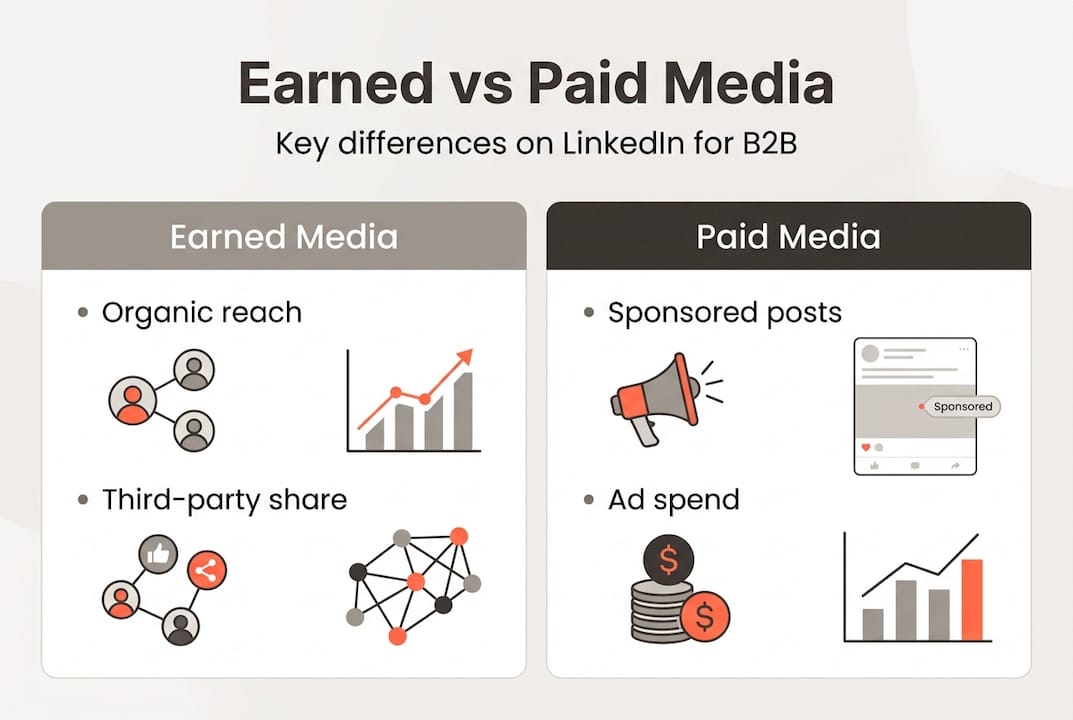
Paid and earned media aren’t competitors. They’re complements. But knowing when to lean on each is what separates reactive marketers from strategic ones.
| Factor | Earned media | Paid media |
|---|---|---|
| Trust level | High (third-party credibility) | Moderate (brand-controlled) |
| Cost | No direct spend | Budget required |
| Control | Low | High |
| Time to impact | Slower, compounding | Immediate |
| Measurability | Complex | Straightforward |
| Longevity | Long-lasting | Ends with budget |
Earned media is more trusted by audiences than paid, while paid allows control but delivers less authenticity. This isn’t just a soft claim. B2B buyers are sophisticated. They research vendors, read peer reviews, and pay attention to who’s talking about a brand organically.
“Consumers trust third-party endorsements significantly more than brand-controlled messaging, making earned media a critical trust signal in B2B purchase decisions.”
When earned media delivers higher ROI for B2B:
- Late-stage pipeline influence: A prospect who sees a peer endorse your brand is more likely to convert than one who sees an ad.
- Brand reputation building: Organic mentions accumulate into a credibility record that paid media can’t replicate.
- Niche community penetration: In tight B2B verticals, earned mentions from respected voices carry outsized weight.
- Long-term SEO and visibility: Organic LinkedIn content that gets shared improves your brand’s search footprint over time.
- Budget-constrained periods: When ad spend is frozen, earned media keeps visibility alive.
One misconception worth correcting: earned media is not free. It requires significant investment in owned content, employee time, and relationship building. The cost is just indirect. A strong brand strategy with LinkedIn accounts for both the direct costs of paid and the indirect costs of earned.
Expert strategies to boost earned media on LinkedIn
Generating earned media at scale requires a system, not just good content. Here’s a five-step process that B2B marketing teams can operationalize.
- Post with a point of view. Generic content gets ignored. Posts that take a clear stance, share proprietary data, or challenge conventional wisdom get shared. Give your audience something worth amplifying.
- Engage before you publish. Brief two or three internal advocates or trusted partners before a post goes live. Ask them to engage early. This primes the algorithm and signals momentum.
- Tag strategically. Mention customers, partners, or industry voices who are genuinely relevant to the post. A well-placed tag can pull a high-follower voice into your thread organically.
- Monitor and respond fast. Use LinkedIn notifications and social listening tools to catch every mention. Responding quickly shows you’re present and builds goodwill with advocates.
- Follow up offline. When someone shares your content or gives you a meaningful mention, send a direct message. That relationship is the seed of future earned media.
Use owned thought leadership to seed earned media, and track both influence and ROI as you scale. This means treating every piece of content as a potential catalyst for third-party amplification, not just a standalone asset.
Pro Tip: Set up a simple tracking sheet that logs every organic mention, share, and unsolicited endorsement your brand receives on LinkedIn each month. Over time, you’ll see patterns in which content types and topics generate the most earned media, and you can double down on those.
For deeper execution, explore LinkedIn partnerships for B2B impact and build a repeatable LinkedIn marketing workflow around these principles. Strong content marketing steps that integrate earned media can significantly accelerate lead generation.
Measuring and maximizing the impact of earned media on LinkedIn
Impression counts are vanity metrics. Real earned media measurement goes deeper, tracking sentiment, engagement quality, and actual pipeline influence.
| Metric | What it measures | B2B LinkedIn benchmark |
|---|---|---|
| Engagement rate | Likes, comments, shares per impression | ~5.2% for top performers |
| Organic impressions | Reach without paid boost | Varies by network size |
| Mention volume | Third-party references to your brand | Track monthly growth |
| Sentiment score | Positive vs negative tone of mentions | Aim for 80%+ positive |
| Conversion influence | Pipeline deals touched by earned media | Track via CRM tagging |
Impact should be measured by sentiment and conversions, not just impressions. One empirical example: 340 posts generated 12,000 followers and 2 million organic impressions, demonstrating the compounding power of consistent earned media activity.
Tools and methods to monitor your earned media on LinkedIn:
- LinkedIn Analytics: Track post reach, follower growth, and engagement breakdowns natively.
- Brand mention tools like Mention or Brandwatch to catch third-party references outside your direct notifications.
- CRM tagging: Label inbound leads by source and note when they engaged with or shared your LinkedIn content before converting.
- Social listening dashboards: Aggregate sentiment data across LinkedIn and other platforms for a unified view.
- Manual tracking sheets: Simple but effective for small teams monitoring organic mentions weekly.
Earned media also has a compounding SEO benefit. When your LinkedIn content gets shared widely, it signals authority to search engines and can drive branded search volume over time. For a full picture, explore LinkedIn analytics for B2B and use a structured approach to measuring LinkedIn ROI. A solid business visibility guide can help you connect LinkedIn earned media to broader growth metrics.
Activate your LinkedIn earned media strategy with Kawaak
Building a consistent earned media engine on LinkedIn takes the right content, the right relationships, and the right infrastructure to track what’s working. Most B2B marketing teams have the intent but lack the system to scale it.
Kawaak connects B2B brands with LinkedIn creators who can amplify your message to highly targeted professional audiences. Whether you want to launch LinkedIn campaigns that blend earned and influencer-driven reach, or build a full B2B LinkedIn influencer campaign with analytics and managed execution, Kawaak gives you the tools to turn organic trust into measurable pipeline growth. Stop leaving earned media to chance and start building it with intention.
Frequently asked questions
What is the difference between earned, owned, and paid media on LinkedIn?
Earned media is organic publicity from third parties without payment, owned is content your brand or employees create and control, and paid is advertising you fund directly on LinkedIn.
How can B2B brands generate more earned media on LinkedIn?
Focus on share-worthy thought leadership with a clear point of view, activate employee advocates to amplify posts early, and prompt engagement from customers and partners through strategic tagging and direct outreach.
Why is earned media on LinkedIn valuable for B2B companies?
It builds authentic credibility that paid ads can’t replicate. Third-party endorsements are trusted significantly more than brand-controlled messaging, making earned media a key trust signal in complex B2B buying decisions.
How do you measure the ROI of earned media on LinkedIn?
Track engagement rate, mention volume, sentiment scores, and pipeline influence via CRM tagging. Measure by conversions and sentiment, not just impressions, to get a true picture of earned media’s business impact.