
TL;DR:
- Authentic influencer partnerships on LinkedIn outperform traditional paid approaches by building trust and relevance.
- Measuring pipeline influence and ROI provides a true assessment of campaign success beyond vanity metrics.
- Micro-influencers offer higher engagement and better ROI in B2B campaigns due to their targeted, trusted audiences.
B2B marketing teams are pouring serious budget into LinkedIn campaigns and walking away with disappointing results. Impressions climb, but conversations stay flat. Clicks happen, but pipeline stays quiet. The problem is rarely the platform. It’s the strategy. Authentic influencer partnerships on LinkedIn consistently outperform traditional paid approaches, and the brands that figure this out early are building real competitive advantages. This guide walks you through exactly how to increase LinkedIn campaign engagement using influencer marketing, from understanding what engagement actually means to measuring the ROI that gets leadership’s attention. 💡
Table of Contents
- Understand what drives campaign engagement
- Pick the right influencers for higher ROI
- Create influencer content that sparks action
- Measure success beyond vanity metrics
- A proven approach most brands overlook
- Amplify your LinkedIn campaigns with Kawaak
- Frequently asked questions
Key Takeaways
| Point | Details |
|---|---|
| Focus on micro-influencers | Authentic B2B partnerships with niche creators consistently outperform mega-influencer campaigns. |
| Prioritize quality metrics | Track pipeline, ROI, and CPL over vanity stats like likes or impressions for true business value. |
| Optimize content for engagement | Use sticky, discussion-driven content and smart link placements to maximize reach and interaction. |
| Measure and iterate results | Constantly review campaign data, adjust partners and content, and report the business impact. |
Understand what drives campaign engagement
Not all engagement is created equal. This is one of the most important things to internalize before you build any LinkedIn influencer strategy. A post with 2,000 likes and zero comments tells you almost nothing about business impact. A post with 80 comments, 15 shares, and 10 DMs to your brand? That’s a different story entirely.
When we talk about types of LinkedIn engagement, the ones that actually predict business outcomes are:
- Comments that ask follow-up questions or share opinions
- Shares that extend your message into new professional networks
- Direct messages triggered by a post that resonated
- Profile visits and connection requests following sponsored content
- Click-throughs to gated assets or landing pages
Likes and impressions are not useless, but they are not conversion signals. Treat them as awareness indicators, nothing more.
Here’s where the data gets interesting. Micro-influencers generate 60% more engagement than mega-influencers in B2B contexts. Why? Because their audiences are tighter, more relevant, and more trusting. A creator with 8,000 highly targeted followers in SaaS operations will outperform a generalist with 200,000 connections every time, at least when your goal is qualified engagement.
| Engagement action | What it signals |
|---|---|
| Comment with a question | Active interest, potential buyer curiosity |
| Share to personal feed | Trust in the content, audience amplification |
| DM to brand or creator | High intent, warm lead signal |
| Save/bookmark | Consideration stage, research behavior |
| Like only | Passive awareness, low intent |
The LinkedIn creators and B2B growth relationship works because trust is already embedded. When a creator speaks to their community, it doesn’t feel like an ad. It feels like a recommendation from a peer. That’s the foundation of quality engagement.
“The goal is not to reach everyone. The goal is to reach the right people in a way that moves them to act.”
Pick the right influencers for higher ROI
Understanding engagement is step one. Making sure you’re working with the people who actually drive it is step two. And this is where many B2B brands make their first major mistake: they optimize for reach instead of relevance.
When identifying LinkedIn influencers for your campaigns, evaluate these characteristics first:
- Follower count vs. engagement rate: A 3-5% engagement rate on a smaller account beats 0.5% on a large one
- Content fit: Does their existing content align with your buyer’s pain points?
- Audience quality: Are their followers actual decision-makers in your target industry?
- Posting consistency: Regular creators maintain algorithmic favor and audience trust
- Authenticity signals: Do they share personal opinions, or just promotional content?
Here’s a practical process for selecting the right partners:
- Define your ICP first. Know exactly who your ideal buyer is before you look at any creator profile.
- Search by niche, not follower count. Use LinkedIn search and creator tools to find voices in your specific vertical.
- Audit their last 10 posts. Look at comment quality, not just volume. Are real professionals engaging?
- Check for brand alignment. Have they promoted competitors? Do their values match yours?
- Start with a small test campaign. Validate engagement before committing to a full partnership.
The ROI case for this approach is strong. Storylane achieved 3x more pipeline efficiency and 10x ROI through targeted influencer partnerships, outperforming their traditional LinkedIn ad spend significantly.
| Factor | Micro-influencer | Mega-influencer |
|---|---|---|
| Engagement rate | High (3-6%) | Low (0.3-1%) |
| Audience trust | Strong, niche | Broad, diluted |
| Cost per campaign | Lower | Higher |
| B2B buyer alignment | Precise | General |
| ROI potential | High | Variable |
For creative LinkedIn campaign ideas, pairing your brand with a niche creator who already speaks your buyer’s language is the most scalable shortcut to authentic engagement.

Pro Tip: Don’t just look at follower numbers. Request a screenshot of their last 30-day post analytics before signing any agreement. Real engagement rates don’t lie.
Create influencer content that sparks action
Once you’ve chosen the right partners, it’s time to create content that compels real interaction. This is where strategy meets creativity, and where too many brands overcomplicate things.
The most effective post formats for B2B LinkedIn influencer campaigns are:
- Curated lists (e.g., “5 tools every RevOps team should know”)
- Opinion posts that take a clear stance on an industry topic
- Polls that invite quick participation and generate discussion
- Video reactions to industry news or trends
- Behind-the-scenes content showing real workflows or results
These formats work because they invite a response. They don’t just inform. They ask something of the reader. That’s the difference between content that scrolls by and content that drives engagement with LinkedIn content.
One critical technical point: place URLs in comments rather than the main post body. LinkedIn’s algorithm deprioritizes posts with outbound links, which reduces reach and dwell time. Keep the post itself clean and engaging, then drop the link in the first comment.
“Brands that prioritize direct outbound links over genuine engagement are trading long-term pipeline for short-term clicks. That’s a losing trade on LinkedIn.”
Look at how HubSpot approaches B2B influencer marketing. Rather than pushing product features through creators, they sponsor content that curates useful resources and insights for their audience. The result is trust, not just traffic.
When working with thought leaders, give them genuine creative latitude. Brief them on goals and audience, then let them write in their own voice. Audiences can detect ghostwritten content immediately, and it kills engagement.
Pro Tip: Co-create content with your influencer partner during a 30-minute call. Share your campaign goals, let them pitch post angles, and build the brief together. The content will feel authentic because it is.
Measure success beyond vanity metrics
With content live and engagement growing, how do you prove what matters most? This is where B2B marketers either build credibility with leadership or lose it. The answer is moving from surface metrics to pipeline metrics.
Here’s a step-by-step approach to measuring real campaign impact:
- Set baseline KPIs before launch. Define pipeline influenced, cost per lead, and conversion rate targets upfront.
- Use UTM parameters on all campaign links to track source attribution in your CRM.
- Tag leads from influencer campaigns separately in your pipeline to isolate their conversion path.
- Monitor engagement quality weekly. Are comments coming from your ICP? Are DMs converting to calls?
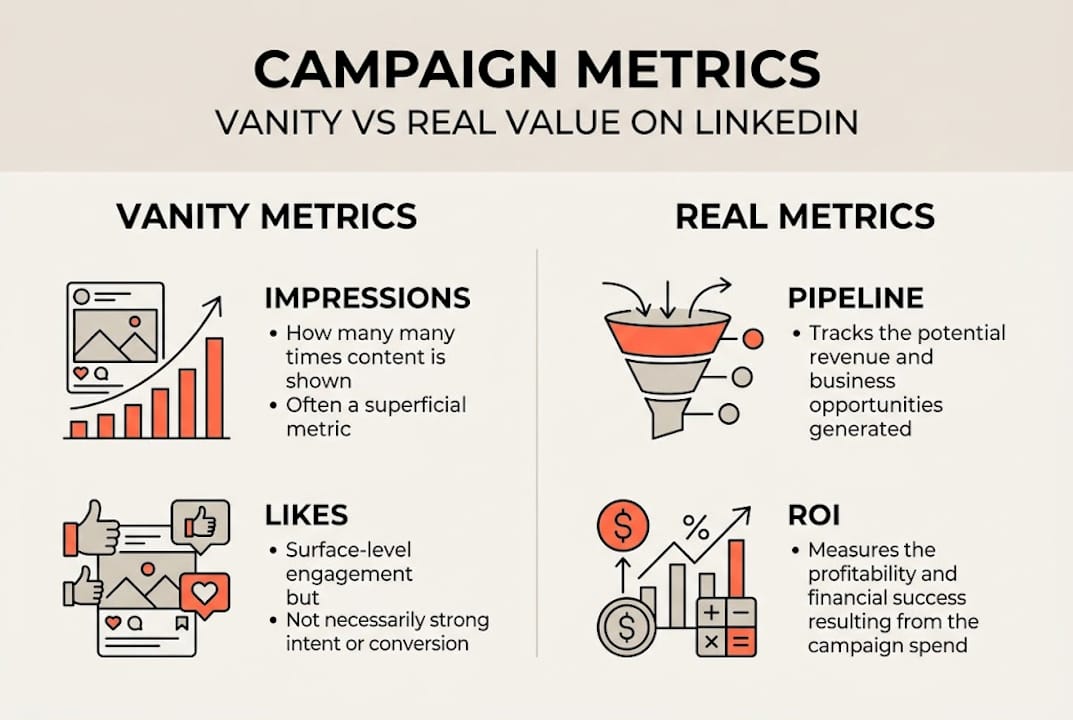
- Report to leadership in revenue terms, not engagement terms. Pipeline influenced is the number that matters.
The results that come from this approach are significant. Brands that track true business impact have achieved a $1M pipeline, 10x ROI, and 50% CPL drop compared to traditional LinkedIn ad campaigns. Those are the numbers that change budget conversations.
| Metric | Vanity version | Real value version |
|---|---|---|
| Reach | Total impressions | % reaching target ICP |
| Engagement | Total likes | Comments + DMs from buyers |
| Traffic | Total clicks | Clicks converting to leads |
| Cost efficiency | CPM | Cost per qualified lead |
| Business impact | Follower growth | Pipeline influenced |
For optimizing LinkedIn analytics for B2B, combine LinkedIn’s native analytics with your CRM data to build a complete attribution picture. This is how you connect a creator’s post to a closed deal, which is the ultimate proof of campaign value. You can also learn from how digital marketing metrics are evolving across other industries to sharpen your own reporting frameworks.
A proven approach most brands overlook
Here’s the uncomfortable truth: most B2B brands are still chasing reach. They sign partnerships with high-follower creators, measure impressions, and wonder why pipeline doesn’t move. The logic feels sound on paper. More reach equals more awareness equals more leads. But it doesn’t work that way on LinkedIn.
LinkedIn is a trust-driven platform. Buyers are not scrolling for ads. They’re looking for insights from people they respect. When a creator with 6,000 deeply engaged followers in your exact vertical recommends your solution, that carries more weight than a sponsored post seen by 500,000 loosely connected accounts.
The brands winning right now are the ones building strategic partnerships for B2B brand impact through ongoing creator relationships, not one-off sponsored posts. Consistency builds familiarity. Familiarity builds trust. Trust scales results, not just reach. 🎯
Too many teams treat influencer marketing as a campaign tactic rather than a relationship-building channel. The mindset shift is simple but powerful: invest in the creator relationship first, and the engagement will follow.
Pro Tip: Commit to at least three consecutive collaborations with a creator before evaluating ROI. Single posts rarely move the needle. Sustained presence in a creator’s content builds the audience trust that converts.
Amplify your LinkedIn campaigns with Kawaak
Ready to move from learning to action? Kawaak is built specifically for B2B marketing teams that want to run smarter LinkedIn influencer campaigns with measurable ROI. The platform connects your brand with vetted LinkedIn creators in your niche, streamlining everything from influencer discovery to campaign tracking and performance reporting.
Instead of spending weeks manually researching creators or managing partnerships through spreadsheets, Kawaak gives you a scalable system that handles the operational complexity. You focus on strategy and results. Whether you’re launching your first influencer program or scaling an existing one, LinkedIn campaign management solutions on Kawaak make the process faster and more effective. Get started with Kawaak today and turn your next LinkedIn campaign into a real pipeline engine. 🚀
Frequently asked questions
What is the fastest way to boost LinkedIn campaign engagement?
Partnering with niche micro-influencers and focusing on actionable, discussion-driven content yields the quickest engagement gains. Micro-influencers generate 60% more engagement in B2B campaigns compared to larger accounts.
How can I avoid algorithm penalties when adding links to posts?
Place campaign URLs in the first comment rather than the main post to preserve reach and engagement. Placing URLs in comments helps avoid penalties and boosts dwell time on the post itself.
Which metrics signal real B2B campaign impact on LinkedIn?
Track pipeline influenced, ROI, and cost per lead instead of just impressions or likes for a true picture of campaign value. Pipeline influenced and ROI give real insights that connect marketing activity to revenue.
Should I work with mega-influencers or micro-influencers on LinkedIn?
Micro-influencers generally deliver more authentic engagement and higher ROI in B2B campaigns. Their tighter, more relevant audiences mean higher engagement and efficiency compared to broad-reach mega-influencer partnerships.
Recommended
- Maximize LinkedIn influence: how engagement drives B2B results
- Why build LinkedIn communities for influencer marketing success – Kawaak
- Creative LinkedIn campaign ideas for B2B marketing success – Kawaak
- How to optimize hashtags in LinkedIn campaigns 2026 – Kawaak
- Social Media Manager – AMB Moving Services
- Email marketing para promotores: sin intermediarios | Blog Soundtix