
TL;DR:
- Expert-led campaigns build trust and credibility crucial for B2B purchasing decisions.
- Niche micro-influencers outperform broad influencers in engagement and conversion efficiency.
- Sustained, relationship-based influencer strategies drive measurable pipeline growth and ROI.
B2B influencer marketing is often misunderstood. Many teams still chase follower counts, assuming that reach alone drives pipeline. But 75% of B2B decision-makers are more likely to trust brands working with industry experts, not generic social personalities. The difference is not cosmetic. It is strategic. Expert-led campaigns speak directly to the way B2B buyers actually evaluate vendors: through credibility, peer validation, and third-party authority. This article breaks down why experts are the real engine of B2B influence, what the data says about ROI, and how you can build an expert-led strategy on LinkedIn that moves deals, not just metrics.
Table of Contents
- Why experts are the linchpin of B2B trust
- ROI and business outcomes of expert-led influence
- Why niche experts and micro-influencers outperform celebrities
- How to activate and engage experts for ongoing influence
- The real edge: What most B2B marketers miss about expert influence
- Amplify your B2B campaigns with expert-led LinkedIn influence
- Frequently asked questions
Key Takeaways
| Point | Details |
|---|---|
| Experts boost B2B trust | Brands collaborating with industry leaders earn dramatically higher trust and credibility from buyers. |
| ROI outpaces traditional campaigns | Expert-led initiatives deliver up to 647% ROI, outperforming basic influencer marketing strategies. |
| Micro-influencers win on relevance | Smaller, niche experts consistently outperform celebrities in generating leads and engagement for B2B brands. |
| Always-on partnerships drive effectiveness | Continuous collaboration with relevant experts produces consistently successful outcomes across channels. |
| Measure what matters | Focusing on pipeline and share of voice yields better results than tracking likes or impressions. |
Why experts are the linchpin of B2B trust
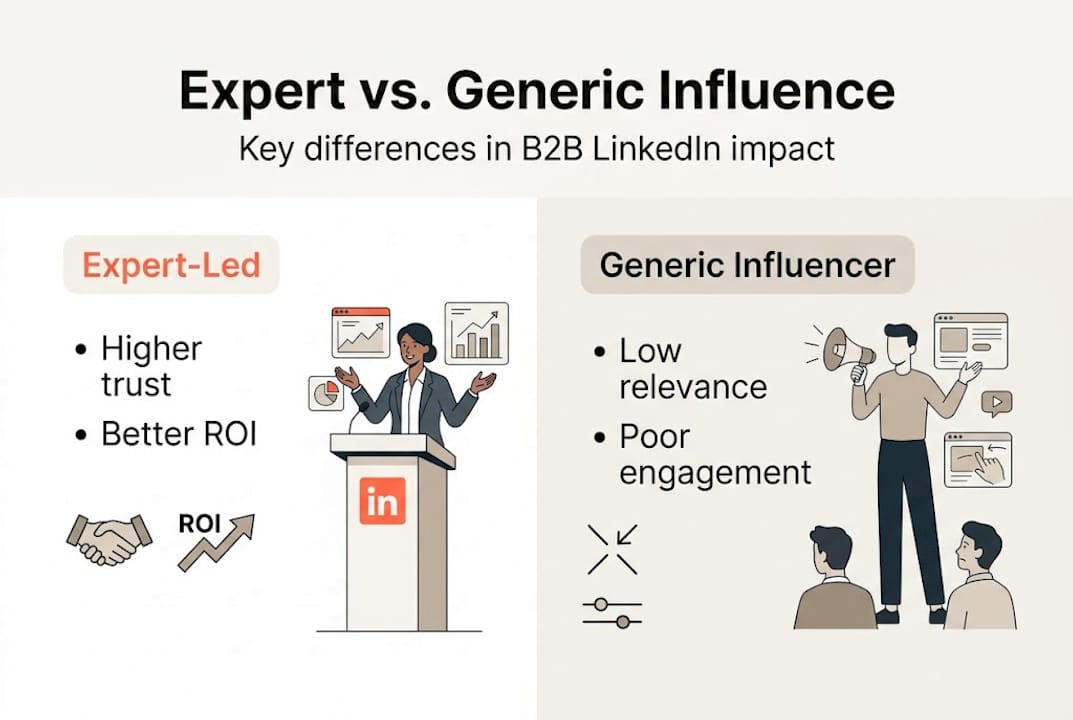
In B2B, trust is earned differently than in consumer markets. A buyer signing off on a $50,000 software contract is not swayed by celebrity endorsements or aesthetic Instagram feeds. They want to hear from people who have faced the same problems, made similar decisions, and can speak to outcomes with real authority. That is a fundamental shift in how influence works at the enterprise level.
“88% of B2B buyers trust brands more when associated with respected figures in their industry.”
This is not just about name recognition. It is about the signal that expert association sends to risk-averse decision-makers. When a respected analyst or seasoned practitioner vouches for a solution, it de-risks the purchase decision in ways that branded content simply cannot. And 72% of B2B buyers trust industry analysts and peers more than vendor-produced content, reinforcing why third-party expert voices are so powerful.
Think about the stakeholders involved in a typical B2B purchase. You have procurement, IT, finance, and the end-user team all weighing in. Each of them benefits differently from expert involvement:
- Procurement teams reduce vendor risk by referencing endorsements from recognized industry figures
- IT and technical buyers trust practitioners who have implemented similar solutions in real environments
- Finance stakeholders gain confidence when ROI frameworks come from credible, independent analysts
- End users feel validated when peers or community voices recommend a tool they will rely on daily
To boost B2B marketing with experts, you need to move beyond thinking of influencers as content amplifiers. They are credibility transfer vehicles. And the most effective ones are industry practitioners, niche analysts, and LinkedIn creators whose audiences already trust their judgment. As CMOs trust LinkedIn influencers more than ever as part of their growth mix, the case for expert-led influence has never been stronger.
Now that we understand why expert involvement is critical for credibility, let’s examine the tangible business impact of expert-led B2B campaigns.
ROI and business outcomes of expert-led influence
Let’s talk numbers, because the performance gap between expert-led campaigns and generic influencer activations is significant. B2B influencer marketing delivers an average ROI of 520%, with high-performing campaigns reaching up to 647%. And 94% of marketers report that influencer campaigns produce measurable success. Those are not vanity metrics. That is pipeline.
📊 ROI comparison: Expert-led vs. generic influencer campaigns
| Campaign type | Average ROI | Lead quality | Buyer trust impact |
|---|---|---|---|
| Expert-led (niche practitioners) | Up to 647% | High | Very high |
| Generic influencer (broad reach) | 100-200% | Medium | Low to moderate |
| Brand-only content | Below 100% | Low | Low |
One standout example is Cherwell Software, whose niche expert campaign generated 22% of annual sales leads in a single activation. That kind of result comes from tight audience fit, not raw reach. When the expert speaks directly to the pain points of a well-defined buyer segment, the conversion efficiency is incomparable.
💡 Statistic callout: 94% of B2B marketers report influencer campaigns as effective, but the top performers consistently use subject-matter experts over mass-market personalities.
Pro Tip: When evaluating potential LinkedIn experts for your campaign, prioritize authority and relevance over follower count. A practitioner with 8,000 engaged followers in your exact niche will outperform a generalist with 80,000 passive followers every time. Look for thought leaders in B2B who already create content your target buyers consume and trust.
The path from expert partnership to pipeline growth is shorter than most marketers expect. When content carries genuine credibility, it moves faster through buyer networks and generates qualified interest at every stage of the funnel. Tracking LinkedIn engagement for B2B alongside deal attribution gives you a fuller picture of how expert-led influence is actually performing.
While the numbers highlight impressive returns, understanding which experts truly drive impact is essential.
Why niche experts and micro-influencers outperform celebrities
It might seem counterintuitive. Shouldn’t a bigger audience mean bigger results? In B2B, the opposite is often true. Micro-influencers and niche experts outperform large influencers because of audience relevance and trust, two factors that matter far more than raw reach when you are targeting specific buyer personas.
Here is why the math works in favor of niche expertise:
- Higher engagement rates: Niche audiences are more actively invested in the creator’s content
- Direct relevance: The expert’s followers already match your ideal customer profile
- Authentic credibility: Micro-experts are seen as peers, not distant celebrities, making endorsements feel genuine
- Better conversion efficiency: Relevant audiences act on recommendations at higher rates
- Lower partnership cost: Niche experts often deliver superior results at a fraction of celebrity rates
Thought Leader Ads on LinkedIn show 252% higher CTR compared to standard ad formats. That number alone should shift where you allocate your next LinkedIn budget.

| Dimension | Niche expert / micro-influencer | Celebrity / macro-influencer |
|---|---|---|
| Audience relevance | Very high | Low to moderate |
| Engagement rate | High (3-8%) | Low (1-2%) |
| Trust level | Peer-like, high | Aspirational, moderate |
| Cost per qualified lead | Low | High |
| Fit for B2B pipeline | Strong | Weak |
The Cherwell Software example is instructive again here. They did not partner with the most famous voices in the tech space. They identified practitioners with targeted audiences, and the result was 22% of their annual leads from a single niche campaign. That is the power of audience fit over audience size.
Start your process by identifying LinkedIn influencers based on topic authority and audience composition, not follower counts. Then track performance using LinkedIn campaign metrics that reflect real business outcomes. AI tools in digital marketing are also making it easier to map expert audiences to buyer personas with precision.
Now that you’ve seen how micro-experts outperform broad-reach influencers, let’s dive into strategies for engaging them effectively.
How to activate and engage experts for ongoing influence
Finding the right expert is only the starting point. Sustained results come from building structured, ongoing relationships rather than one-off sponsored posts. 97% of B2B marketers say thought leadership with experts is critical to their strategy, and 74% of those collaborating frequently with influencers find their content highly effective. Frequency and depth of collaboration matter.
Here is a practical five-step framework for activating B2B experts on LinkedIn:
- Find and map experts: Identify practitioners, analysts, and LinkedIn creators whose audiences overlap with your buyer personas at each stage of the journey
- Vet for fit: Review their content history, engagement quality, and existing audience sentiment before outreach
- Activate with co-created content: Start with formats that showcase their expertise, such as webinars, LinkedIn Lives, or contributed posts
- Collaborate on always-on content: Move beyond one-off campaigns toward recurring touchpoints like podcast series, ebooks, or monthly insight posts
- Measure what matters: Track share of voice, pipeline attribution, and deal influence, not just likes and impressions
Always-on strategies yield 99% effectiveness according to marketers who implement them, and 53% of B2B marketers plan to increase their influencer budgets in the next cycle. The shift toward sustained partnerships over transactional campaigns is where the real compounding value lives.
Pro Tip: Integrate expert influence directly into your sales enablement toolkit. When your sales team can share a webinar clip featuring a trusted industry practitioner, it carries far more weight than a product one-pager. Connect partnering with industry experts to your CRM and content strategy so every touchpoint is measurable and purposeful.
Content formats to prioritize for expert-led campaigns include webinars, podcasts, LinkedIn newsletters, long-form collaborative posts, and ebooks. These formats give experts room to demonstrate genuine depth, which is what builds buyer confidence. Building LinkedIn strategic partnerships this way also creates SEO and brand equity that persists well beyond any single campaign cycle. For broader B2B partnership efficiencies, integrating influencer efforts across your marketing stack is increasingly a competitive necessity.
Having explored activation strategies, let’s examine the bigger picture, where expert influence fits in B2B marketing’s evolving ecosystem.
The real edge: What most B2B marketers miss about expert influence
Here is what most teams get wrong: they treat expert influence as a distribution tactic rather than a trust-building strategy. They measure likes, shares, and impressions, then wonder why pipeline is not moving. The real value of expert-led B2B influence is not amplification. It is credibility transfer at scale.
“Between 44 and 87% of B2B buyers prefer third-party expert content over vendor advertising when making purchase decisions.”
That gap is enormous. Your buyers are actively filtering out your branded messages in favor of voices they already trust. Expert influence is not a workaround for that reality. It is the only scalable solution to it.
The other pitfall? Thinking too narrowly about who counts as an influencer. Your influence ecosystem includes analysts, industry association leaders, practitioners with a modest but loyal LinkedIn following, and even internal champions at customer accounts. Expanding your view of who shapes buyer opinion will reveal influence levers you are currently ignoring.
📌 Focus on building an influence ecosystem, not just running influencer campaigns. Map every third-party voice that touches your buyer journey and activate them strategically. Use creative LinkedIn campaign ideas to keep expert content fresh and relevant across the entire funnel, not just at the top.
Measure share of voice. Track deal attribution. Ask your sales team which content pieces actually come up in buyer conversations. Those are the signals that tell you whether your expert influence strategy is working.
Amplify your B2B campaigns with expert-led LinkedIn influence
If this article made one thing clear, it’s that expert-led influence is not a nice-to-have for B2B brands. It is a measurable growth driver. The question is how you build it efficiently and at scale.
Kawaak connects B2B brands directly with vetted LinkedIn creators and industry experts who are ready to sponsor content that resonates with real buyer audiences. Whether you are launching your first expert-led campaign or scaling an always-on influence program, launch LinkedIn campaigns through a platform built specifically for this. Explore how B2B influencer solutions from Kawaak can help your team move from content production to pipeline generation with the right expert voices backing your brand. 🚀
Frequently asked questions
How do you choose the right LinkedIn expert for B2B influence?
Prioritize industry practitioners and analysts with direct relevance to your buyer’s specific challenges, then map them to the buyer journey stages where their credibility will have the greatest decision-making impact.
What formats work best for expert-led B2B influencer campaigns?
Webinars, podcasts, and ebooks combined with always-on LinkedIn partnerships consistently deliver the strongest combination of buyer trust, pipeline growth, and long-term audience credibility.
How is ROI tracked for B2B influencer campaigns?
Track pipeline impact, share of voice, and deal attribution as your primary signals. Vanity metrics like likes miss the point entirely, as demonstrated by how niche experts generated 22% of annual sales leads for Cherwell Software through audience-fit-driven campaigns.
Do all B2B brands benefit from expert-led influence?
Not always. Commoditized products may require technical proof and direct demonstrations over influencer-driven content, making expert influence more valuable for complex, high-consideration B2B purchases where trust is the primary conversion barrier.